Before I lived in Southeast Asia, I thought I knew how to stock a pantry.
I had olive oil, salt, pepper, a few dried herbs, and maybe some soy sauce if I was feeling adventurous. I bought ingredients for recipes, not for a system. My pantry was reactive — I bought what I needed for the specific dish I was making that night.
Then I moved to Bangkok. And I watched how people actually cooked.
It changed everything.
Southeast Asian home cooks do not stock pantries the way Americans do. They do not buy ingredients for recipes. They buy ingredients that can be used in multiple ways, across multiple dishes, across multiple weeks. Their pantries are not collections of specialty items. They are toolkits.
I borrowed that mindset. It made me a smarter cook. Here is what I learned.
Lesson 1: Build a Pantry of Verbs, Not Nouns
American cooking culture tends to think in nouns — ingredients with fixed identities. You buy soy sauce for stir-fries, fish sauce for Thai food, miso for Japanese food. Each ingredient belongs to a specific cuisine.
Southeast Asian cooks think in verbs — what an ingredient does. Fish sauce is not a "Thai ingredient." It is a savory amplifier. Coconut milk is not a "curry ingredient." It is a fat that carries flavor and balances heat.
Once you start thinking in verbs, you stop seeing borders between cuisines. You see tools. A tool can be used anywhere.
Examples:
Ingredient | Noun Thinking | Verb Thinking |
|---|---|---|
Fish sauce | Thai/Vietnamese condiment | Umami booster, salt replacer |
Coconut milk | Curry base | Dairy alternative, heat balancer |
Miso | Japanese soup paste | Savory thickener, glaze base |
Tamarind | Pad thai ingredient | Acid source, sweetener |
Gochujang | Korean chili paste | Fermented heat, umami layer |
Rice vinegar | Sushi seasoning | Mild acid for any dressing |
How it changed my cooking: I stopped thinking about "Chinese food" and "Thai food" as separate categories. I started thinking about what each ingredient could do for whatever I was cooking that night.
Lesson 2: Stock the Fermented Stuff
American pantries are light on fermentation. We have vinegar, maybe Worcestershire, maybe mustard. That is about it.
Southeast Asian pantries are fermentation-heavy. Fish sauce, shrimp paste, soy sauce, fermented bean pastes, pickled vegetables. Fermentation is not a specialty. It is a backbone.
Why this matters:
Fermented ingredients are flavor multipliers. They do not just add their own taste — they make everything around them taste more intense, more complex, more satisfying. A teaspoon of fish sauce in a pot of chili is not adding "fish flavor." It is making the chili taste more like itself.
What I keep stocked now:
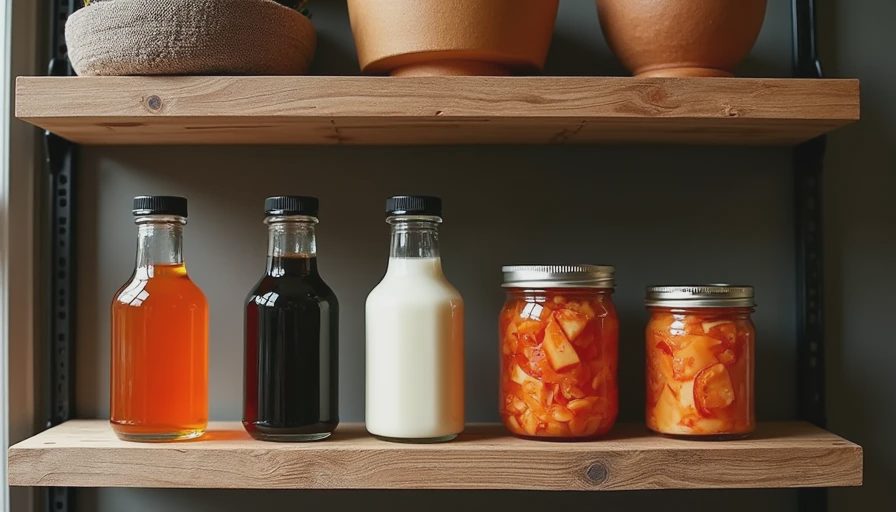
Fish sauce
Soy sauce (light and dark)
Miso (white, kept in the fridge)
Gochujang (also in the fridge)
Rice vinegar
A jar of pickled vegetables (usually daikon and carrot)
These are my fermentation anchors. Everything else can be fresh.
Lesson 3: The Three-Second Rule for Shopping
I noticed something about how people shopped at the markets in Bangkok and Ho Chi Minh City. They did not stare at ingredients. They did not comparison-shop for ten minutes. They walked up, pointed, paid, and left.
It took me a while to understand why. It was not because they were impulsive. It was because they had a home base set of ingredients that they knew worked. The market was not for deciding what to eat. The market was for replenishing what they already knew how to use.
What this looks like in my kitchen:
My pantry has a fixed set of staples. When I shop, I am not standing in the aisle trying to figure out what I need. I am checking what is running low and buying more of it.
The fresh ingredients change weekly. The pantry staples are constant. That makes shopping fast and decision fatigue low.
My fixed staples:
Neutral oil
Fish sauce
Soy sauce
Rice vinegar
Coconut milk (canned)
Gochujang or miso (whichever I am using more that season)
Rice (jasmine and short-grain)
Dried noodles
Everything else is negotiable.
Lesson 4: Use the Whole Thing
Southeast Asian cooking is not wasteful. Not in a performative "nose-to-tail" way — in a practical "this is food, why would you throw it away" way.
Stems of cilantro go into stir-fries. Vegetable peels become stock. Chicken bones simmer into broth. Nothing is a "scrap" unless you decide it is.
What I do now:
Herb stems go into the freezer for broth
Vegetable trimmings become quick pickles
Chicken bones go into a pot with onion and ginger for stock
Leftover rice becomes fried rice the next day
Overripe fruit becomes a sauce or a salsa
It is not about being a zero-waste hero. It is about not paying for food twice. You bought it. Use it.
Lesson 5: Your Pantry Is a System, Not a Collection
The biggest shift was mental.
I used to think of my pantry as a collection of ingredients. I would look at it and think, "What can I make with what I have?" That question is fine. But it is reactive.
Now I think of my pantry as a system. The system has inputs (what I buy) and outputs (what I cook). The system works when the inputs are predictable and the outputs are flexible.
My system:
Input | Purpose |
|---|---|
Fish sauce, soy sauce, miso | Umami |
Rice vinegar, lime, tamarind | Acid |
Coconut milk, oil, butter | Fat |
Chili flakes, gochujang, garlic | Heat and flavor |
Rice, noodles, flour | Base |
Those five categories cover almost everything I cook. If I have something from each category, I can make dinner. It will not always be the same dinner. But it will always be a dinner.
What Southeast Asian Pantries Taught Me About American Pantries
I am not saying American pantries are wrong. I am saying they are often understructured.
We buy what looks good. We buy for specific recipes. We buy what is on sale. We buy things that look interesting and then do not use them.
Southeast Asian pantries are not about maximizing variety. They are about maximizing usability. The goal is not to have more ingredients. The goal is to have ingredients that work together.
I have adopted that philosophy. My pantry is smaller than it used to be. But I waste less and I cook more.
The Takeaway
The habits I learned in Southeast Asia were not about specific ingredients. They were about a mindset.
Stock ingredients that do multiple jobs.
Prioritize fermentation. It is flavor insurance.
Shop to maintain a system, not to follow a recipe.
Use everything you buy.
That is the lesson. It is not about cooking Thai food or Vietnamese food. It is about cooking smarter.
— Elena
No comments yet — grab the first one.